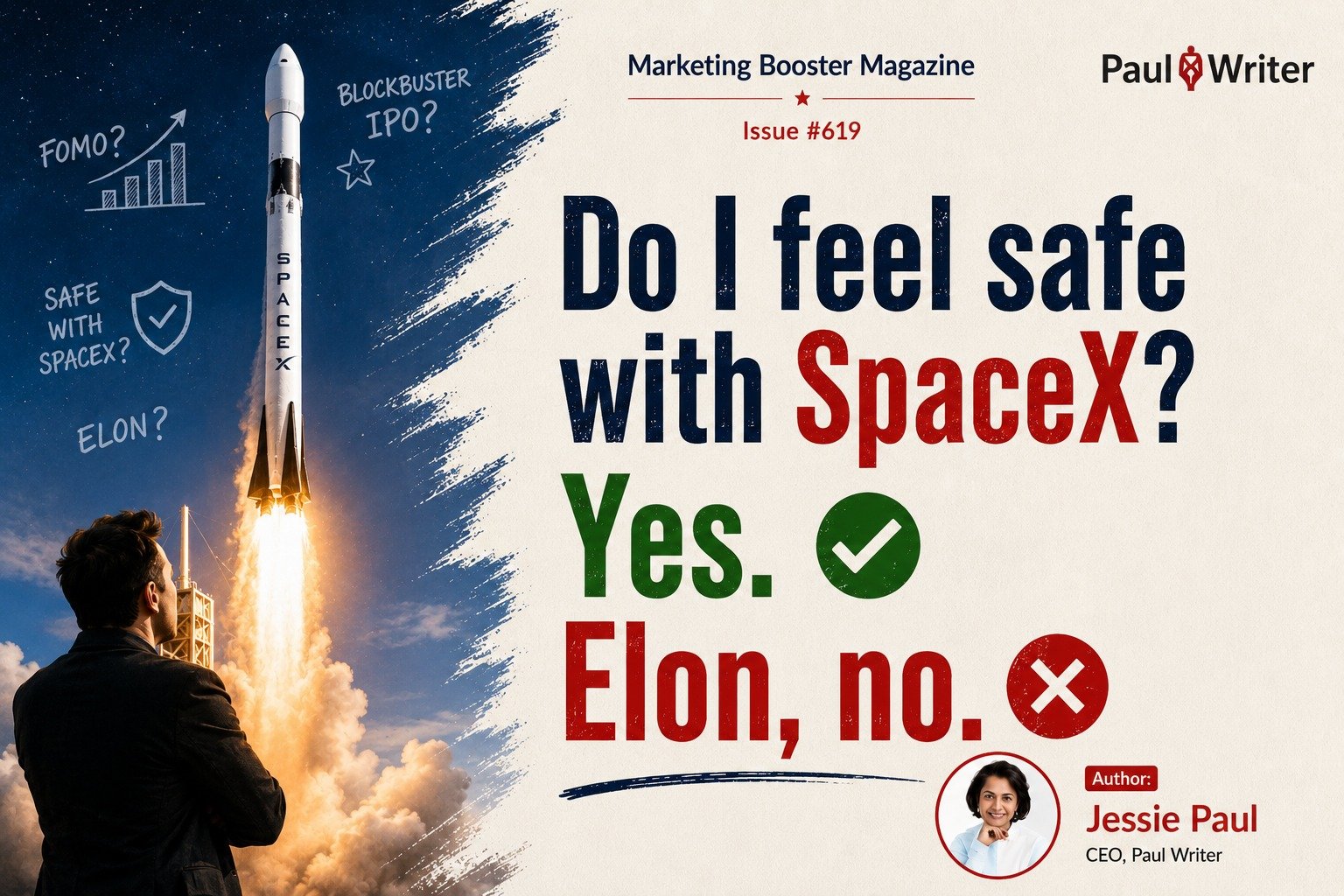
I’d definitely not feel safe with Elon. In any context. But the SpaceX IPO? At some point I felt the FOMO. A wish to be a part of the winning team as it became clear this was going to be a blockbuster IPO. And if it wasn’t? Well, I’d be wrong with a bunch of other people.
If you’re wondering I did not figure out how to participate in the IPO from India and therefore will not be writing the next issue of this newsletter from a new yacht.
Misery loves company – that’s a brand insight.
We all want to belong – brands help us to fit in somewhere. And part of the benefit of that is that when things go wrong we feel a little bit better. We are not alone.
Amanpreet Bajaj, Country Manager of AirBnB India writes about this in his recent post on why completely random locations can go viral because someone said it was great on Whatsapp. And we, as humans, trust the herd.
Brands are Safety
I grew up being told what to wear – by my parents, school, society. I never did develop the confidence to create my own style, even when these strictures no longer held.
I do not count roaming the halls of Infosys in the 90s wearing lime green “floaters” a sartorial choice. It was about finding a group of people who really did not care about footwear as long as our brains did the work. My boss at the time, Sudha Kumar, used to walk into the Chairman, N R Narayana Murthy’s office barefoot at times.
When I could afford to make my own fashion choices, I went the way of safety – choosing clothes from “respectable” brands. That way, even if the clothing choice was “wrong” my brand choice was “right” and I wouldn’t be judged. You might be thinking “ouch, who wears shoes like that?!” but when you realized that they were Louboutins, you’d be like ah, it must be fashionable. At least that’s the hope.
And if you’re the kind of person who DOES recognize a Louboutin, then you’d have a feeling of kinship with me.
B2B Brands are About Trust. Who will do well in the World of AI?
Beyond knowing that AI is going to be the next big thing, noone has absolute certainty on what this means or what they should do about it. We do know that if we don’t adopt and adapt, we’ll be dead in the water. That’s true for individuals as well as businesses.
Every business wants to “embrace AI”. While demonstrated competency is a necessity, customers want someone that will stick with them through this journey and prove that they will invest in figuring out what needs to be done.
In my view two kinds of businesses will do well.
One, the established names like Infosys and Wipro because even if they can’t cope you will have plenty of company to share your troubles with. Refer the section on misery loves company/trusting the herd. They have maintained fantastic retention rates over decades – a sure sign that they do generally try to do well by their customers. They have guided customers through Y2K, Dotcom boom/bust, Financial crisis et al.
Second, the smaller firms that also have fantastic retention rates and have a history of 20+ years. These firms too have a proven track record of sticking by their customers, and guiding them through uncharted territory. Process and client centricity are the bedrock of a great company. They will provide you with direct access to their experts for brainstorming and figuring out the options available to you, so may functionally deliver more than the established names.
In either case, they need to work on building their brand imagery around trust.
Claude just alienated me. Pun intended.
You should never love anything that can’t love you back. That applies to AI interfaces too.
Claude is the “chatbot” from Anthropic (they too are planning a blockbuster IPO this year). It definitely makes my work easier and gives me advice on all sorts of things, chanelling experts I never thought I’d be able to access.
Anthropic, the parent of Claude, keeps upgrading the underlying models to be more clever. Recently they launched Fable 5, but due to security concerns the US government told them they cannot allow access to this model to any non-US citizens.
The opposite of building a brand of togetherness is othering. Where a brand clearly says that it isn’t for you. I immediately felt alienated. And remembered the Cray vs Param days of yore, when the US banned the export of the hotshot supercomputer.
Anthropic did the right thing – they pulled the model for EVERYONE, including their own employees. Which was nice of the brand, but it did impact my trust in it. An enterprise cannot put all its eggs in a basket outside of its control. Worse, outside the control of the person selling the basket and promising to look after it!
What can you do?
My advice to clients is to focus on establishing trustworthiness. The AI competency is the second layer, not the first.
This is true for individuals too.
I was really touched by a reader I met recently who told me that they liked my newsletters because they counted on me to keep them updated on what’s new!
Cheers to humans writing to humans!
I am always happy to hear what you think about the newsletter – make my day! Write in!
Have a great week ahead!
Lorem ipsum dolor sit amet, consectetur adipiscing elit. Ut elit tellus, luctus nec ullamcorper mattis, pulvinar dapibus leo.