
Brand positioning in the age of AI now has two lanes. A broken pair of boots showed me why.
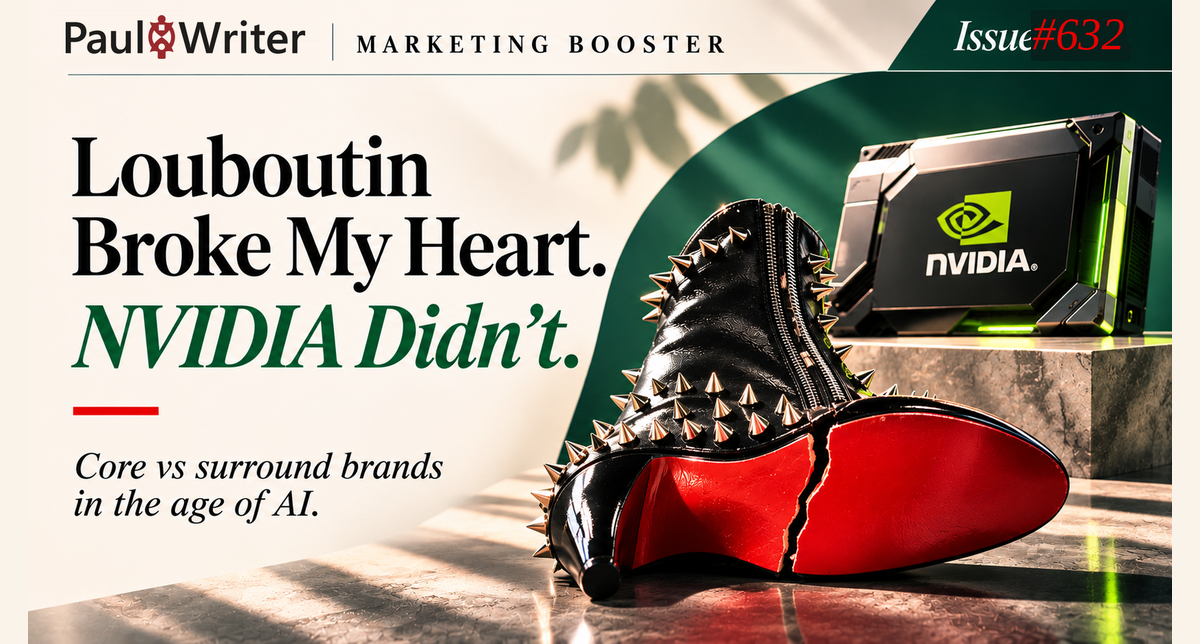
I was seated next to a famous celeb and while I didn’t recognize her I was intrigued by her sandals – red soles and spikes on the leather. Pre-AI I needed Deepali Naair to tell me that the shoes were from a brand called Christian Louboutin – famous for trademarked red soles. I don’t wear high heels but when a pair of boots appeared on a vintage site I could not resist – the red soles and spikes were mine.
I use them sparingly, but an outing to NMACC in Mumbai last week I thought merited these special shoes. And indeed I enjoyed the conversations they sparked – including a chance meeting with Hamsa Mahmood.
And the next day the iconic red sole of one shoe split in half. Whaaaat!
The red sole IS half the brand! I am shattered. Soul-broken, in fact.
Brand positioning in the age of AI: needs vs wants
In the 2-lane marketing highway we now operate in, AI recommends for your needs while humans buy for their wants.
If you ask AI for the best boots, it has a sensible range of brands like Clark’s and Aldo. If you specify you want red soles, then it asks whether you want Louboutin.
A red sole has no functional value whatsoever. But it might talk to your soul
Louboutin is a surround brand, yet what broke my heart was a functional failure. The surround layer only works if the core holds. That’s the twist that brand owners must remember.
Core vs Surround Brands
When I talk to clients about positioning, it is important to understand whether they are a core or surround brand.
A core brand sells on functionality. It addresses a need – arrive on time, quench thirst, protect your feet, wear a white shirt, write on paper.
A surround brand delivers on the functionality, but adds layers to the experience. Travel Emirates Business, feel you have arrived, drink Evian and feel that you have had a short trip to France, wear Nike shoes and feel like you’re an athlete, dress in Tom Ford and experience your inner James Bond, write and feel like Agatha Christie with a Montblanc – the list goes on.
Many organizations start as a core brand and then evolve to a surround brand as the functionality gets commoditized.
Infosys appointing a tennis star like Carlos Alcaraz as Global Brand Ambassador is a surround move. He adds aura, not capability. It does nothing for the deliverables of the vast majority of its clients. He also represents Evian, another surround brand that goes well beyond quenching thirst. As I say in my book, Marketing Without Money, Infosys has always leaned towards surround branding.
What about NVIDIA?
NVIDIA sells on its platform excellence, which it built on its first mover AI advantage. They have trained a huge AI developer community. There are performance benchmarks to determine whether their chips are good, and there is lock-in from its early start. That is what makes it a valuable company.
Its competitor AMD missed the AI boat and is playing catch-up. In both cases the AI market is based on competence not softer factors.
Which is also why despite all the muck around their reputation, buyers will continue to buy from NVIDIA. Selling to China might not be nice from a US interest perspective, but it doesn’t impact the performance of the chip. The Board not knowing its own mind is definitely problematic, as is the concentration of power in one person, but again, doesn’t immediately impact the performance of their platform.
So buyers gonna buy. Until there is an alternative or better option.
And because no one has an emotional bond with NVIDIA, there is no heart to break. It doesn’t have a celebrity brand ambassador either. (Except its own CEO, of course.)
Brand positioning in the age of AI: which brand are you?
Work out why customers choose you, whether you can sustain that advantage, and how. Then build a marketing plan for both lanes. That is brand positioning in the age of AI.
If you are a functional brand, win the AI lane with proof points. If you are a surround brand, win the human lane with experience. And never let the core crack.
Many brands start as functional and move towards surround as they run out of feature runway.
So which are you, core or surround? Reply and tell me.
Happy Thanksgiving
Today is the US festival of Thanksgiving. I don’t agree with its colonial overtones. But it is a nice opportunity to remember to thank everyone who has been a part of my journey.
Thank you everyone for continuing to read and engage with me.
I raise a glass of cranberry juice to all of you today!
Cheers!
Yours in humanity
Jessie Paul
About the author: keeping it real here
Jessie Paul is an independent board director, former Wipro CMO, author and founder of Paul Writer. She specialises in brand strategy, AI and turning chaos into frameworks. A compulsive researcher, she believes every problem deserves a strategy, every strategy a PowerPoint, and even buying coffee warrants a competitive benchmarking exercise.