
Executive summary
Marketing in the age of AI now runs on two lanes. AI agents shortlist on needs. Humans decide on wants. A brand that wins only one lane can lose discovery and/or the sale.
- Buying has split in two. Agents filter on criteria they can verify. People keep the final say and apply their own preferences.
- Every brand is core or surround. Core brands sell on function. Surround brands sell function plus experience. Each needs a different plan.
- Core brands win both humans and AI with proof. Structured data, benchmarks and third-party validation.
- Surround brands must teach machines what people want. Gifting value, resale value and social proof have to become data an agent can find.
- Wants are built where machines cannot reach. Events, sampling and storytelling still decide the final human choice.
- Friction now kills sales. Captchas and gated accounts lock out agents, and the customers behind them.
- The surround rests on the core. A surround brand that fails on function loses both.
The shift in marketing in the age of AI: every purchase is now two decisions
AI recommends for your needs. Humans buy for their wants. That is the Two-Lane Marketing Highway, and every brand now operates on it. Marketing in the age of AI has to win both lanes.
My experience is that the clearest evidence comes from asking an agent to shop. I asked Claude for the best gold ring. It scored rings on purity, quality, resale value, making charges and wastage, then recommended a plain hallmarked ring from a known jewellery chain. When I asked about Cartier, it pointed out that Cartier is 18K, not 22K, and that I would be paying for the brand, not the gold. It allowed one exception: gifting and status.
A milk query ran the same way. Claude recommended Akshayakalpa on purity and nutrition, and added lab testing and sourcing traceability as criteria I had not asked for.
The agent decided what mattered. Cartier’s 180 years of storytelling counted for nothing in that shortlist. But people have wants that go beyond functional attributes. I need a phone. I want an iPhone.
| Lane 1: the machine | Lane 2: the human | |
|---|---|---|
| Decides on | Needs: verifiable, comparable criteria | Wants: identity, status, belonging, feeling |
| Evidence it trusts | Structured data, certifications, reviews, benchmarks | Stories, peers, experiences, physical encounters |
| Your job | Get into the consideration set, backed by proof | Be the choice once the shortlist exists |
| Failure mode | Never shortlisted | Shortlisted, never chosen |
The framework for marketing in the age of AI: core brands and surround brands
The first question I ask any client is whether they are a core or a surround brand. The answer decides which lane they must win first.
A core brand sells on functionality. It addresses a need: arrive on time, quench thirst, protect your feet, store your data, write on paper. A surround brand delivers the function and adds layers of experience. Fly Emirates Business and feel you have arrived. Drink Evian and feel you have had a short trip to France. Wear Nike and feel like an athlete.
My experience is that many organisations start as core brands and become surround brands as their functionality gets commoditised. They run out of feature runway.
| Diagnostic | Core brand | Surround brand |
|---|---|---|
| Why customers choose you | Performance, price, reliability | Identity, status, feeling, story |
| Primary lane | Machine | Human |
| What the agent sees | Strong: benchmarks, specifications, track record | Weak: the agent sees function and ignores the layers |
| Proof that matters | Data, benchmarks, certifications | Social proof, gifting value, resale value |
| Ambassador role | Rarely needed | Adds aura, not capability |
| Example | NVIDIA: platform excellence, developer lock-in | Louboutin: the red sole is half the brand |
Infosys appointing Carlos Alcaraz as Global Brand Ambassador is a surround move. He adds aura, not capability. NVIDIA, by contrast, has built its position on platform excellence, a trained developer community and performance benchmarks. Buyers keep buying despite reputational noise, because none of it changes how the chip performs. Until there is an alternative or better option.
Seven principles for marketing in the age of AI
1. Plan for two buyers: the agent that shortlists and the human who chooses
The agent narrows the field on needs. The person then applies wants. Marketing in the age of AI that speaks to only one of them is half a plan.
So what: Audit every touchpoint twice, once as a machine would read it and once as a person would feel it.
2. Know which brand you are before you plan anything
Core brands sell on function. Surround brands sell function plus experience. Marketing both the same way wastes money in one lane and loses in the other.
So what: Write down, in one sentence, why customers choose you. If the sentence is about performance, you are core. If it is about feeling, you are surround.
3. Core brands: win the machine lane with proof
An agent has no patience for adjectives. NVIDIA is chosen on platform excellence, performance benchmarks and developer lock-in. That is proof an agent can verify.
So what: Publish structured, third-party-backed proof points. Benchmarks, certifications, specifications and customer data, in a form a machine can read.
4. Surround brands: teach the machine what people want
Agents judge on parameters they already know. If your value lives outside those parameters, you vanish from the shortlist. Cartier’s example: gifting value, auction resale data and local testimonials are criteria an agent can use, if you put them in front of it.
So what: Convert your intangibles into data. Resale prices, gifting occasions, reviews and press, structured and findable. This goes beyond machine-written FAQs.
5. Build wants in the physical world, where agents cannot go
The end user keeps the final say, and their stated preferences narrow the agent’s search. Wants form through experience. Conferences work for B2B. Sampling works for B2C. Storytelling still makes a product feel better than its functional equivalent. Evian is the example: water that feels like a trip to France.
So what: Treat events, sampling and storytelling as the way you create the preference that steers the agent.
6. Remove friction: an agent that cannot transact will buy elsewhere
My elder-care supplier used captchas that blocked my agent from creating an account. My agent could not access BigBasket or Amazon, so the purchases moved to Blinkit and Licious, which were easier to transact with. To a seller, all agents look alike, but the owner behind each one may have needs that must be handled at fulfilment. B2B agentic buying will demand even harder data and clearer guardrails.
So what: Marketing in the age of AI includes being easy to buy from. Test your own site with an agent. Every captcha, forced login or hidden price is now a lost customer.
7. Never let the core crack: the surround rests on function
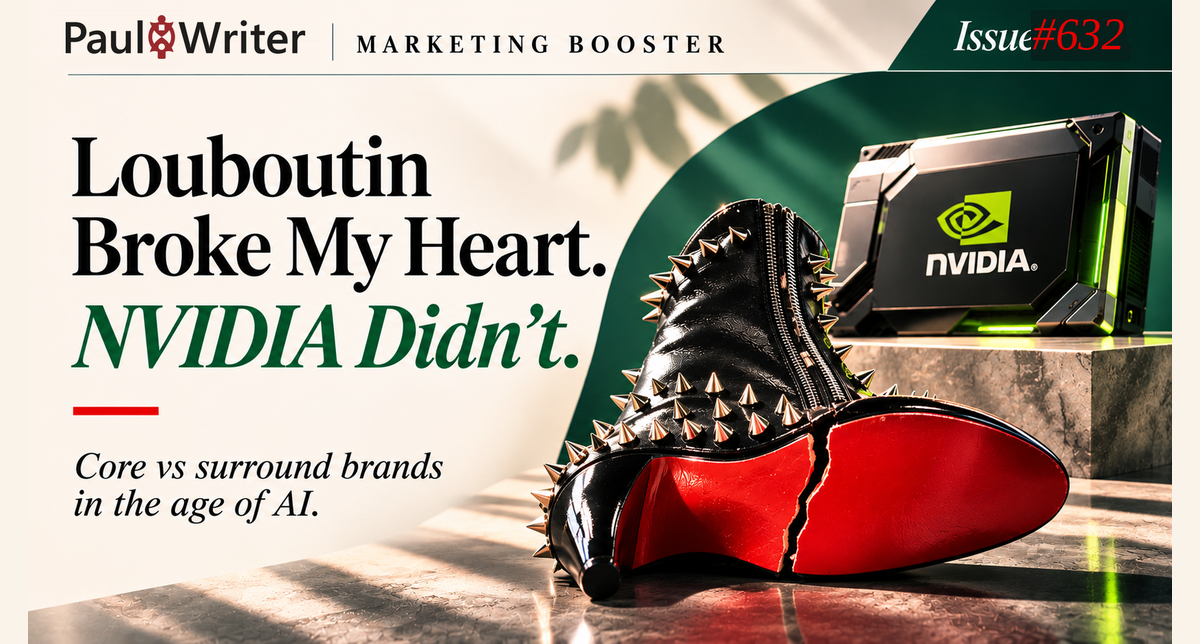
Louboutin is a surround brand. The red sole is half the brand. Yet what broke my heart was a functional failure: the sole split. The experience layer only works if the core holds.
So what: Fund the functional promise before the storytelling. Quality failures cost surround brands more, because customers paid a premium for the feeling.
Marketing in the age of AI playbook: what each brand type does differently
| Core brand | Surround brand | Brand in transition | |
|---|---|---|---|
| First lane to win | Machine | Human, then machine | Both, in sequence |
| Content | Proof pages, benchmarks, specifications | Stories, experiences, social proof | Proof first, then story |
| Data you publish | Performance, certifications, pricing | Gifting value, resale value, testimonials | Both |
| Human touch | Community and developer trust | Events, sampling, ambassadors | Start with events |
| Main risk | Commoditisation as features converge | Failing on function | Losing the core while chasing the story |
A 90-day agenda for marketing in the age of AI
- Days 1–30: Diagnose. Decide whether you are core or surround. Ask an AI agent to shop for your category and record whether it shortlists you, and on what criteria.
- Days 31–60: Fix the machine lane. Publish structured proof. Remove captchas, forced logins and hidden prices that block agents from transacting.
- Days 61–90: Build the human lane. Put events or sampling in place. Turn your intangibles into data an agent can use.
Five questions for the leadership team
- Why do customers choose us, in one sentence?
- Does an agent shortlist us today? On what criteria?
- What proof can a machine verify without our help?
- Which wants do we build, and where do people experience them?
- If our functional promise failed tomorrow, what would our story be worth?
Closing: technology should serve the craft
Gandhi wanted machines as tools that reduce human labour without displacing people. The Singer sewing machine let people keep their craft and their connection to what they made. The power loom turned workers into button-pressers.
We face the same choice with AI. Marketers can use it to serve human wants, or to strip them out. My view is clear. The brands that win at marketing in the age of AI will use machines to be found and people to be chosen.
Be the Singer, not the power loom.