
I hardly know what Kim Kardashian does these days. Rajnikanth’s birthday was a mere blip in my consciousness. If you want to know about Ranbir Kapoor’s 43rd birthday or the significance of Timothee Chalamet wearing neon orange, you will actually have to initiate a search for it.
The death of “I’m feeling lucky”
I used to get information that had no immediate purpose while scrolling on Facebook or any online news site. Occasionally one would hook me enough to research it further. Now AI browsers- I am using Comet – sit on top of search and tightly curate your information. No gossip for you. Just facts. And paid ads.
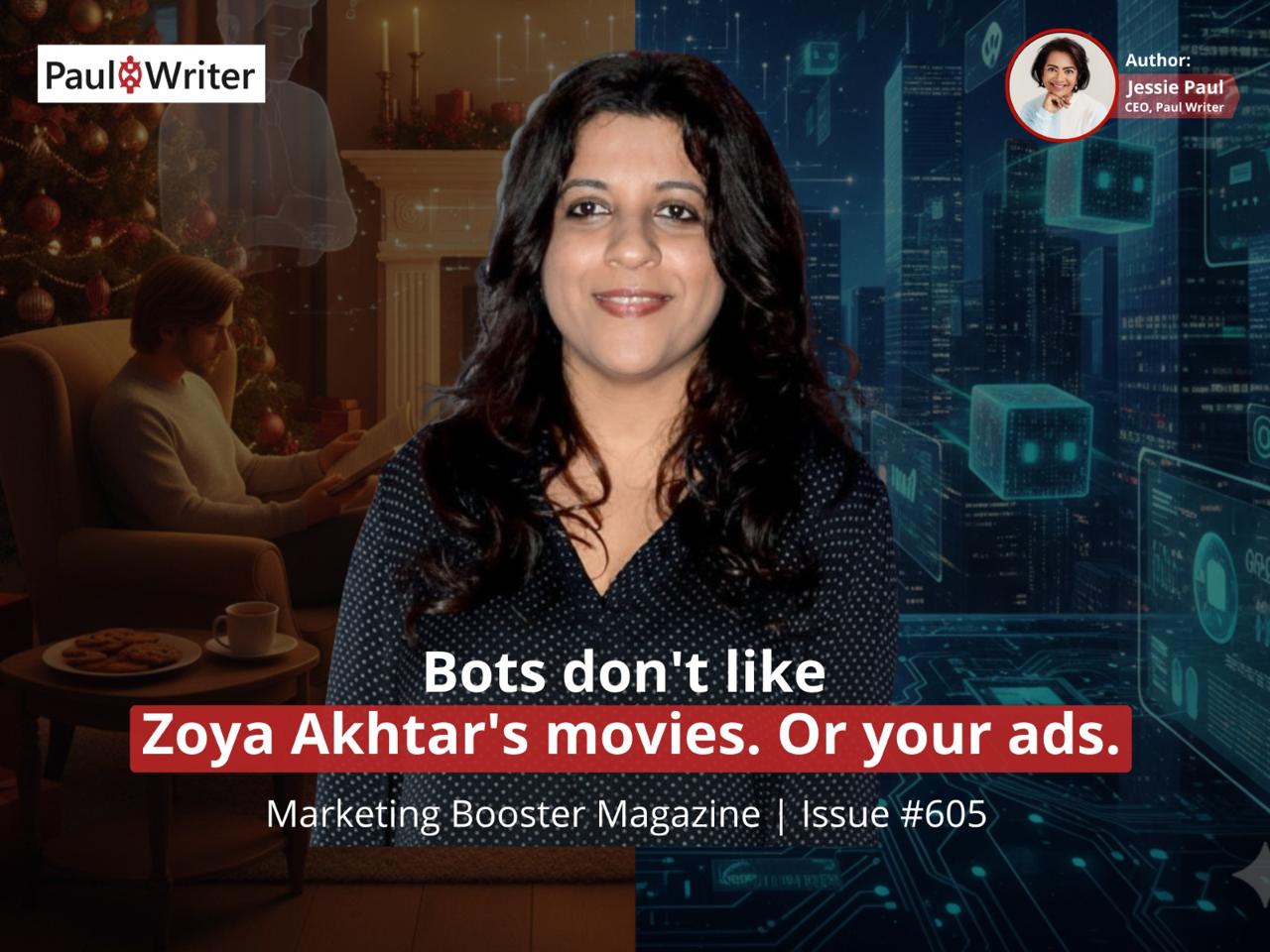
I heard Zoya Akhtar (Director of Gully Boy and Zindagi Na Milegi Dobara) speak about narrative at Indeed FutureWorks Conference 2025 in Bangalore. The session was about how we tell our stories and those of our organizations. Zoya said that she enjoys going to the theatre to watch movies, but is saddened by audience members who are constantly on their phones. By certain measures, our median attention span or ability to focus is around 45 seconds these days.
How do we communicate with this fidgety audience?
What about the bots?
The bots don’t like ANY stories. They just want data. They’ll summarize movies in a way that you get the story plot, but not care in the least bit about the characters. Try it – Perplexity gave me an excellent plot summary of Zindagi Na Milegi Dobara. What it missed was Zoya’s explanation that the whole movie is intended to capture the spirit of a road trip, that feeling of sitting still but actually moving. The concept stemmed from her love of road trips.
The ever-present bots in my computer are offering to “polish” this email. The results are factually correct but absolutely no fun to read. I think you’d prefer human to human communication, errors and all! Say yes, please, pretty please! Help a soul out here!
My bot challenges your bot
What happens when an AI built resume meets an AI tool. They deliver the facts. But can humans be entirely reduced to facts? For example, if I say, “I’m fine” you, as a human, use other senses to read if I really am fine or not. If my eyes are downcast during the interview, it could be because I am shy.
Or it could be that I am reading answers from a screen to help 🙂
We’re in the early days of bots being able to read emotions, so for now humans must still be involved.
As per Varun Mayya (1 million subscribers on YouTube!), another speaker at the conference, we need to think way more visually. For example, a Job Description hardly describes what we actually do in a day. It would be way more meaningful for potential employees to have a vlog of “one day in the life of ___role”.
Oh and his suggestion to go viral? Just do 300 posts a year 🙂
In answer to why if it is so simple everybody doesn’t go viral, his answer is that everyone could have a six-pack if they went to the gym 300 days a year, but most of us lack consistency. So there.
From controlling eyeballs to your wallet
The bots – and their bosses – control what you see, and what you don’t. At present you are still the decision maker who authorizes spend, even if it is based on information that is less than MECE – Mutually Exclusive, Comprehensively Exhaustive – (thank you, Sanjay Joshi for drilling this into me way back in Infosys!). But with Agentic AI, the bots will also shop for you.
As a consumer, I have soo many questions about how I will be sure they are acting in my interest and not that of their owner!
As a marketer, this is totally exciting. It will be like a whole parallel marketing universe where our bots market to the customer facing bots. It will require a completely different approach because the bots don’t care for storytelling – but our end customers still do!
How can we help the bots to read emotions?
How do we cue “luxury” in machine language?
Katja Forbes explores this in her article on selling to machines.
2026: from SEO to Intent Optimization
I just made that phrase up 🙂
Rather than random browsing, now our screen time is more intentional. It may still be a waste of time, but it is intentionally so. You choose to read news on a particular site because you have paid for it. You see beauty products on Instagram because you have let the platform know you like it. I am stuck with US news as my primary consumption, because well, I paid for NYT to access the recipes and er, Wordle.
How do I shape the intent of the consumer?
Then, separately, how do I shape the intent of the buyer-bot?
This is the big shift of 2025. Like SEO, but instead of optimizing only for human eyeballs we will also optimize for bot views and decision. Or we should.
Christmas is round the corner!
This has been a year of change for me. I relocated from Singapore back home to Bangalore. And it really has take almost 10 months to completely settle back. But for now, I am enjoying the food, weather and quick delivery (despite numerous glitches and being almost mowed down by the delivery drivers every now and then.)
I hope Sinterklas is good to you!
Email is sort of the last bastion of human communication, so please do write in and support a fellow fallible human 🙂
Happy Holidays!