
I saw my first computer in 1980. Impressed me enough to want to study computer science in college which, in the 90s, was a fantastic choice. At NIT Trichy, I had to code on a shared computer in a “Computer Lab” because they were so expensive. In Tata Elxsi, time on the Silicon Graphics machines – the same ones that were used to create Michael Jackson’s “Black or White” video – was tightly rationed.
The mid-80s supercomputer, the Cray-2 cost $32 million in today’s money, filled a room, and needed a dedicated power supply. An iPhone 17 can match it in computing power.
We have experienced a world where we getting better and better speeds and power for less and less money. Until now.
AI is a compute guzzler
When you assign a task to Claude or ChatGPT, you can watch it think as it works its way through the steps. All of this consumes a fair bit of computing power. For most of us, this compute power lives in the cloud, not on our aging desktops. And already those who are paying the monthly subscription are getting better results than those on the free models.
If you need to run it on your own computer, say, because you were training the AI or building an LLM, a high-end NVIDIA desktop could set you back around $400K. That’s a serious investment in tech.
And if you are building out the cloud on which AI relies for the computing power, you would have to pony up the money to build it now, and hope that you were able to sell the capacity in a few years.
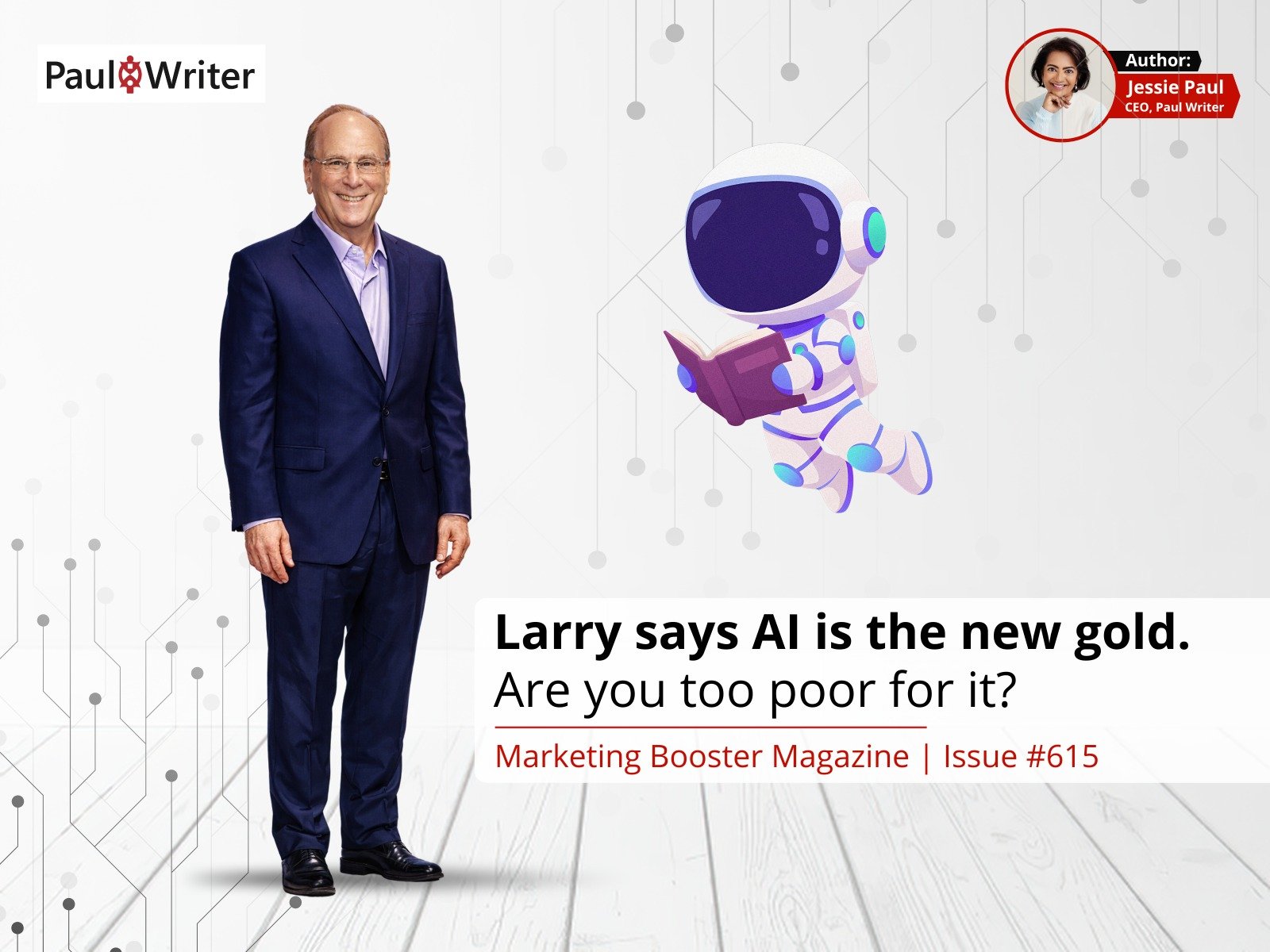
Why did Larry Ellison fire 30,000 people?
The big news of this week was that Oracle – Larry Ellison is the Chairman and founder and CTO – fired roughly 18% of its workforce. Despite growing well. Why?
Well, the analysis is that they need cash flow, and that eliminating jobs will deliver that. They have raised around $50 billion in debt and equity to fund the approximately $156 billion committed to building out AI data center infrastructure.
It is part of a massive pivot – from ERP to SaaS to a hyperscaler. Unlike the old license-based ERP or the modern SaaS based Oracle which are still essentially services companies, a hyperscaler will be a huge capex investment with revenue hopefully kicking in later on.
What’s your AI strategy
I recently sat through a strategy presentation which covered everything in terms of making the business better. But did not reimagine what an AI-enabled customer would look like.
Making everything a little better using AI is not really enough any more. If your industry is impacted by AI, then “better marketing” is also not going to solve all revenue issues. You need to also relook at your product strategy and how it fits in with the way the world is moving.
It’s about the money, honey 🙂
I made a cute gif for a birthday invitation. Took me a few minutes using (paid) Claude and (paid) Canva. I can make lovely videos for Birdsong Life using original photos shot by the teen team – using a $40 tool. All these fees will become not just cost of business but potentially cost of living.
AI adoption is expensive. And results are not yet predictable.
Indian IT industry was successful because it did not need massive capex investments and relied on cost arbitrage of humans. Will that sustain in this new era? What happens to my former employers like Infosys and Wipro?
I tested a hypothesis with, er, Claude and got this visual which paints a rather dire picture.
My first job was with Tata Elxsi which monetized its ability to invest in Silicon Graphics machines and Elxsi mainframes. Services offered were around privileged access to this hardware. We seem to be heading into that phase again.
Where should you look for gold?
Ability to leverage AI is a business essential. The best tools are NOT free. So explore and build your AI stack, keeping in mind that the landscape is changing every week. Analyse your business to see whether there are large industry forces at play.
For example:
1. Will buying authority be human or AI?
2. If there is perfect information, will your product still be a great fit?
3. Is aggregation now possible and will that lead to industry consolidation?
The infinitely scalable business with a headcount of ONE
Medvi is a telehealth provider that claims to have hit a billion dollars in revenue under two years selling GLP-1 weight loss drugs. It’s been a one-person operation for most of its existence, but has added the founder’s brother and a few contractors. Everything else is agentic AI. Cool no? And yes, since it sells other-people’s-products it is essentially a massive marketing and fulfillment machine.
Let’s go dig for gold 🙂
Wishing those who celebrate it a Blessed Good Friday and Happy Easter.