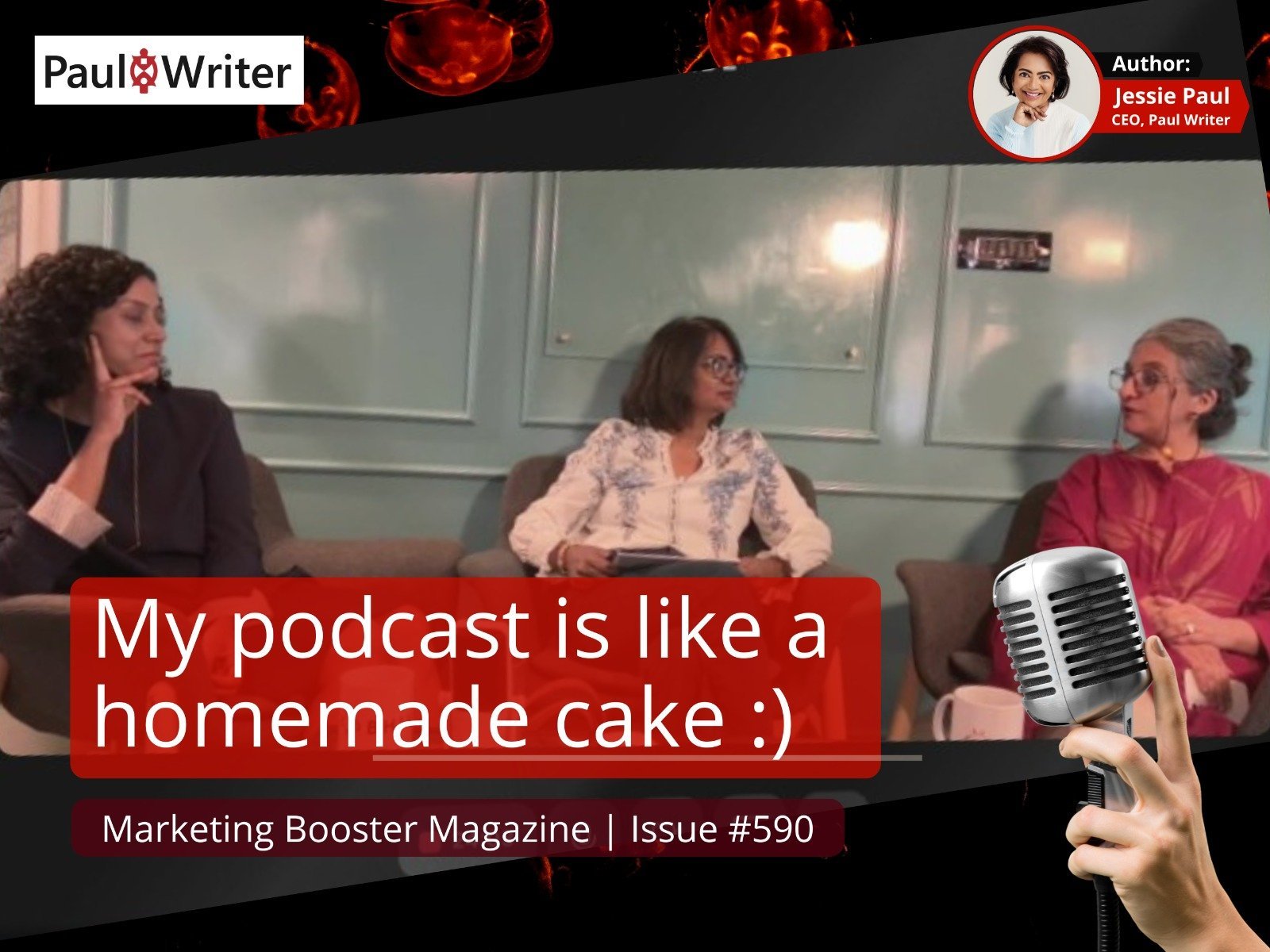
How can you stand out even when you don’t have a ton of money to burn? That’s the topic of my shiny new podcast. And because I want to make use of the power of AI while retaining the authenticity of my voice, I have chosen to do this as an end-to-end project – I script, record, edit and upload each of the podcasts and clips myself. I am totally revelling in this creative experience – a return to the craftsmanship of communication. Yes, there are flaws, but I hope you will accept it as a part of the authenticity of the experience.
Thanks to Payal Nath, co-founder Kadam Haat, Radhika Mahadevan, founder, Birsdong, Cathy Chandhok, CMO, QualityKiosk, Poornima Couto, CMO, SLK Software, Anu Raj, CMO, Mahindra Finance, Smita Murarka, Marketing Expert, Monisha Devaiah, AVIXA for sportingly agreeing to be the first cohort of my podcast guests. Thanks to BHIVE my coworking partner for allowing me to use their space for shoots. March 8 is International Women’s Day so I kicked off my podcast with marketing leaders.
Why would I not outsource this podcast? Because I think we are on the cusp of a new era, an AI enabled era, where creators will be freed from the mechanics of execution. But in order to benefit from automation, you need to first understand the process in all its nuances. Let me do a throwback to 1998, the dawn of digitization for me.

“I was kidnapped in the line of work” – Payal Nath, co-founder, Kadam Haat. How is that for a screening question for a new hire 🙂
What is WYSIWYG?
I woke up with a start as the super fancy colour printer in Sharad Haksar’s photo editing studio ran out of paper. Me, Sharad and our art director, Shivan were doing a night out in the studio to refill the paper as we printed a mock-up of Infosys’ first corporate brochure.
“Can you handle making one corporate brochure a year?” I was asked in my interview for the role of brand manager at Infosys. At Ogilvy and Mather in those days we took a week or two to make a brochure so I confidently answered, yes. I got the job and soon discovered that there was a slight mismatch of understanding of the work involved. Mr Narayana Murthy introduced me to the phrase “WYSIWYG” which in those days of dot matrix printers was er, difficult. But we persevered and though it took 6 months the output was beautiful – amazing photos, crafted content and lovely paper. I wish I had a copy – it was art.
That brochure was craftsmanship – every bit was carefully created by experts. Today between a chat tool and Canva it is possible for anyone to create a corporate brochure in around an hour. It will however lack authenticity, a differentiated messaging, and maybe even factual accuracy. It will just add to the massive amounts of polished blah that is flooding the internet.
But a day or two should suffice for a fairly nuanced and good looking piece of communication to be created by someone who understands communication and design.
The end of the corporate video
The corporate brochure was very well received by the sales team and the clients. I wish I could say the same for the corporate video. That project was technically more complicated, took nearly a year to complete, and was a tad outdated by the time it was done. It was too long, too boring, too big a file size, and in its aim of covering everything didn’t talk to any target audience in particular. I learned that it is very hard to create a single story that resonates with multiple clients with complex needs. Videos in those days were expensive and unwieldy and we couldn’t afford one per service line or domain, so I think we just stopped making them till production costs dropped.
CMM Level 5 – for marketing
CMM stands for capability maturity model, and was the bedrock of the Indian IT services industry. Level 5 meant that your processes were repeatable. We applied the same to marketing as well, and as soon as we did something right, had to submit a process document so that it could be replicated by someone who had never done it before. Infosys marketing had documented processes for client visits with sub-processes for gate security and menu selection, our brand guideline was there with the required fonts and paper for business cards and so on. Once a process was documented, it could be repeatedly executed by multiple people. Not everyone could create a process – that required skill, knowledge and craftsmanship. But operating a process reliably and repeatedly required a different set of skills.
Not everyone can create a recipe for a cake, and baking the same cake every day to the same recipe is a different mindset all together.
What does AI do to the creative process
It democratizes it. It separates ideation from the mechanics of execution. But there is still a process to be followed to get a good output. And the skilset required to design the algorithms and workflows is different from the skillsets of execution. It brings down the cost and time of production. If I had to create a video for Infosys today, I wouldn’t. I’d envisage one per defined target audience. Because technology simplifies the mechanics – not the art – of storytelling. It frees us in the pursuit of creating communications and products tailored to a single customer.

I’m going to drop one new podcast every week. Do subscribe to The No Money Marketing Podcast! In each podcast we discuss low cost marketing, the impact of Gen Z on the workplace, leadership challenges and advice for fellow marketers.
Shorts more your thing? Got those too! Here.