
Marketing Mix Modeling: Return on Investment and Optimization
In the last post (archive 2), we examined how the drivers of sales were identified and it was possible to figure out the percentage contribution of each channel.
The percentage can also be converted to volume and value as these percentages are applied to the total sales in that specific period. Let us say that the 25% of sales came from TV and this coverts to a sale of Rs 10 crore(A). Let’s say the cost of TV is Rs 2 crore(B) for the TV campaign – then the ROI is simply 5(A/B). ROI can be computed for each channel and decisions made on increasing or reducing deployment based on the ROI.
The advantage of ROI calculation is that it is channel neutral. It does not matter to the model if the money was spent on TV, below the line or trade promotions, the ROIs of each have the same unit of measurement – return on sales value. This is a relief as other evaluation methods determine what the best plan for a media would be based on a survey and it is not possible to compare the impact of say Outdoor with TV. Moreover the ROI calculation that we have, helps weed out the weak channels and redeploy the money saved on more effective channels.
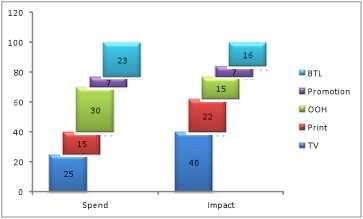
If the spend on a channel is lower than its contribution to Sales value – then that channel has a higher than average ROI.
In this case TV and Print have a better than average ROI
So far so good, the concept is quite simply as long as one has the means to separate out the effects of different media running con-currently. Now we can bring in some associated concepts that help in the process of redeployment.
The first is the concept of diminishing returns. This simply is that as more money is deployed behind a channel – after a point the returns start diminishing and at some point no additional sales occur. Therefore there would be no point in spending beyond this point even if the ROI of this channel is great. The analyst has to find another channel where the potential to deploy more funds profitably exists.
The second important concept is that of optimization. The question that this tries to answer is simply this – “what is the best combination of media that I can deploy if my sales are to be maximized, without increasing the budget”. Given that there may be 5 to 10 variables – the number of combinations possible would be very large, but statisticians can suggest a unique solution or a set of solutions that can deliver the highest sales or at least sales significantly higher than achieved in the past. This output of modeling is pure gold as merely the right usage of data can add to sales – sometimes as high as 5 to 10 percent.
The above optimization helps in deployment of funds across media. Going one step further, it is also possibly to use MMM methodology to deep dive into specific inputs such as TV channel mix, Price sensitivity and Promotion effectiveness. More of this in the next edition!
 Published with permission from RainMan Consulting