Why Marketing Gets CRED Out of Red
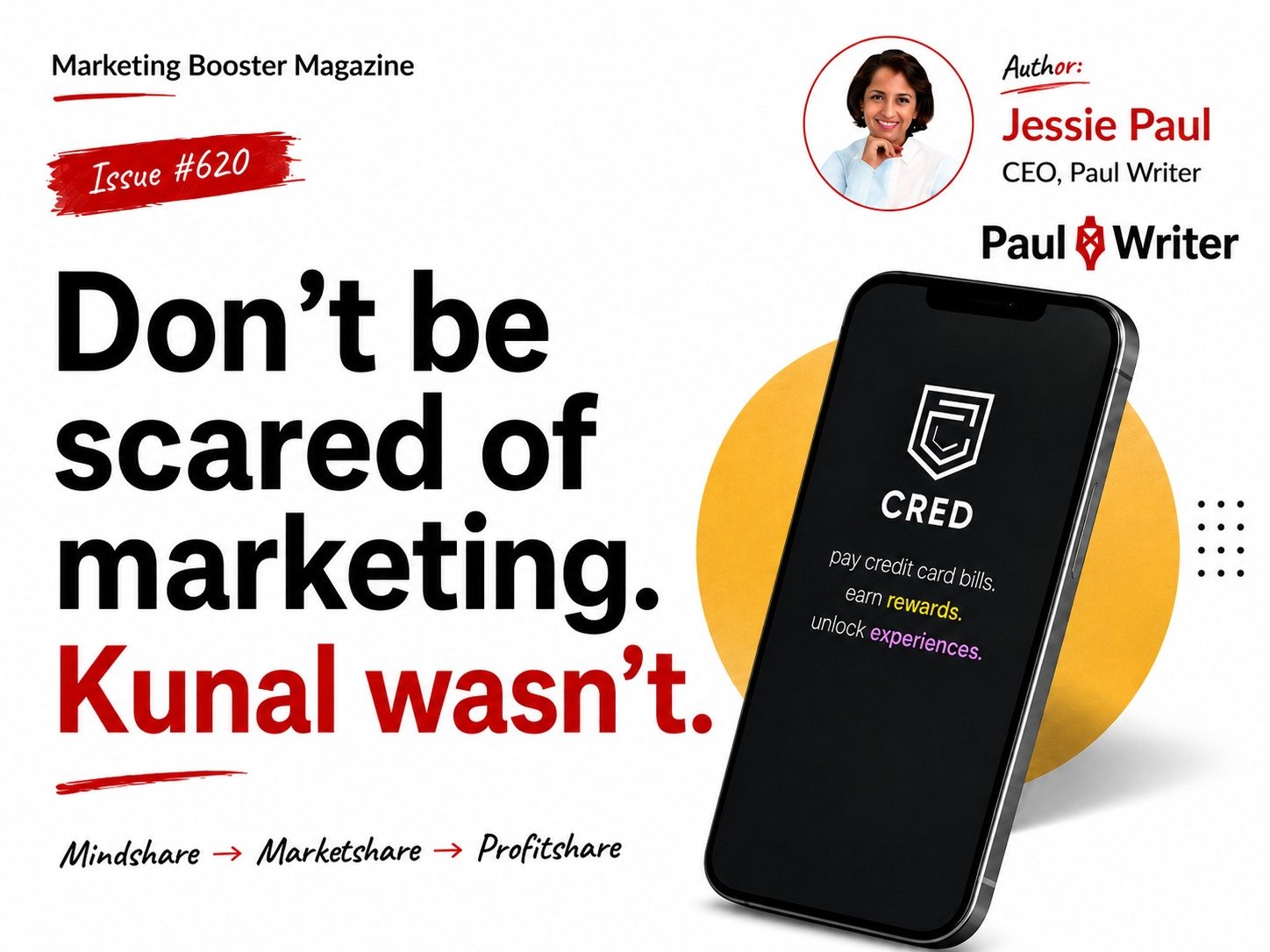
CRED’s near-billion-dollar hire-acquisition by WhatsApp proves a principle I’ve been writing about since 2008: Mindshare leads to Marketshare, which leads to Profitshare. CRED built brand awareness before it had a conventional business model — and that brand became the exit asset.
What made CRED worth a billion dollars to WhatsApp?
CRED is a buzzy brand on IIM Whatsapp groups. First it was the FOMO of not having a fancy enough credit score to get in, then it was the gazillion points accumulated that had nowhere to go (I have over a million), then it was trying to figure out how on earth they made money (they still don’t), then it was like, wow, they actually do have a business model that goes beyond paying credit card bills, then it was privacy concerns, and now it is “Kunal Shah has been hire-acquired for nearly a billion dollars by Whatsapp”.
Why do startups need to invest in marketing before they’re profitable?
One of my squabbles with Indian founders is that they don’t like to invest up front in the brand. We like to grow organically. We say things like “If the product is good, customers will come.” As I said in my 2008 book – and revisited in the 2021 version – there is no point building a better mousetrap if you are unwilling to invest in the cheese. The mice – a.k.a. customers – will simply not find you. Awareness is essential for people to discover the product. The more of your target audience you can reach with your product, the more likely they are to try it, right? Awareness is often expensive – that’s why founders and boards hesitate. It’s also an uncertain area – a startup can’t rely on historical data to assess whether a spend of X will deliver sales of at least 1.2X. In fact, initially, it may not. Which is undoubtedly frightening. And India does have a paucity of good marketers whom you can trust – the reason I wrote my books on Marketing Without Money in the first place – as a DIY for brands that don’t have access to a great CMO. But. There is only so much of scale you can achieve by pure sales or word of mouth. Even word of mouth works better when it is amplified. Gotta bite the bullet of marketing some day! The smart people do it smartly, efficiently, but they do it. And let me clarify that when I say marketing, I do NOT mean advertising only. Even this newsletter is a marketing tool 🙂 I am very happy you are reading it! There’s a great HBR article about why marketing should be at the core of your growth strategy. It says “The results of this research are clear: Companies that make the decision to put marketing at the core of their growth strategy outperform the competition. Specifically, those who view branding and advertising as a top two growth strategy are twice as likely to see revenue growth of 5% or more than those that don’t (67% to 33%). This is true for both B2C and B2B companies.”
What does Mindshare → Marketshare → Profitshare mean?
The logic is that more people know you therefore are likely to buy you and therefore you will eventually monetize the marketshare. In the case of CRED the monetization has arrived via Whatsapp. I wrote about Facebook’s acquisition of Whatsapp back in 2014 as a means for them to buy more of your time. Buying time = Mindshare. Now they have a huge user base of 3 billion and want to figure out how to monetize this. India runs on Whatsapp so yes, pretty sure we will pay for it one way or another.
How much should a startup spend on marketing at launch?
Monopoly Go launched with a marketing budget of $500 million. Yup you read that right. But it clocked $2 billion in revenue in under a year. Launched in April 2023 it still pulls in $200 million per month! Pretty good, eh? I wrote about the launch in newsletter issue #565 and why you should always invest as much as you can afford into marketing. What’s a good investment is entirely dependent on what you are able to reap from it.
Is the CRED–WhatsApp combination a privacy concern?
Cred has access to my spend data. But Whatsapp? It has access to a whole lot more! I confess I scroll. And amongst the “influencers” I read is a chap called Bryan Johnson who is making himself a guinea pig for immortality. He has done 40 and 70 hour social media fasts and his measurable results are very interesting – a seven day fast produces a reduction of anxiety (16%), depression (25%) and insomnia (15%). Intuitively it rings true. Am I ready to take the plunge? Not yet. As of now the only time my phone literally does not work is when I am in the gym (because there is no signal, not by choice.). But when the forces of time consumption join hands with actual spend persuasion, I am concerned. This is me as a human consumer, not as a marketer 🙂
Key Takeaways
-
CRED’s WhatsApp acquisition is a case study in brand-as-exit-asset
-
Mindshare → Marketshare → Profitshare is the sequence Indian founders skip at their peril
-
Companies that prioritise branding grow revenue at 2× the rate of those that don’t
-
Marketing spend is not a cost — it is the cheese in the mousetrap
-
The WhatsApp–CRED data combination is a new frontier for consumer persuasion
Fellow humans, help the algo! If you clicked a link or forwarded this newsletter, you’re sending a positive signal to the AI gatekeepers. Yours in humanity.