A positioning strategy is a strategic marketing plan that helps you determine where your business stands in the market and how it should be positioned to attract more customers.
A poorly positioned product will never reach its full potential no matter how well it is marketed, while an excellent positioning strategy can be all that stands between failure and profitability.
A successful positioning strategy can help companies become an authority in their field, distinguish themselves from competitors for better brand recognition, or even create new markets by identifying unmet needs among consumers. More specifically, businesses may use this type of approach when they are going up against established players who have been around longer as well as those with the more credible distribution channel.
A good brand positioning is one that creates a unique space for the product or service in the mind of the customer.
Wrong positioning can kill a brand. It can do this by making the product unattractive to the right audience or by targeting the wrong audience. Tata Nano is a great example of positioning strategy gone wrong. It was positioned as the poor people’s car. But who wants to drive a car for poor people? Poor people certainly don’t – buying your first car should be an aspirational, joyous experience. And thus a great product was undone by poor marketing.
Cartier is positioned as a luxury. It allows them to charge 10x what a local jeweller does.
The 3 Key Questions of a Brand Positioning Strategy:
As I outline in my book, every brand has to answer these three questions in as unique a manner as possible:
Four main types of positioning strategies
There are four main types of positioning strategies: competitive positioning, product positioning, situational positioning, and perceptual positioning.
- Competitive positioning involves comparing your product or service with that of the competitors.
- Product positioning includes creating benefits for customers by aligning those features with specific needs.
- Situational positioning includes positioning your product as a solution to the specific needs of targeted customers.
- Perceptual positioning includes changing how people feel about their situation by altering perceptions.
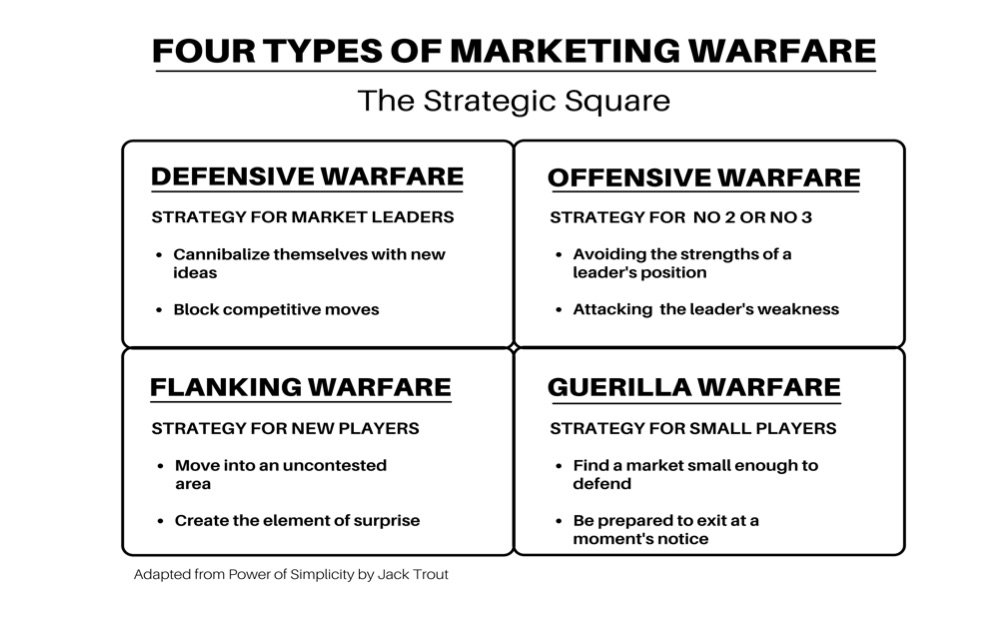
Trout & Ries book on positioning is a mandatory read for anyone studying this space. Here’s an illustration adapted from Jack Trout’s book on the same topic.
Core or Surround Branding? You have to choose!
I believe there are two routes to making your offering stand out – core branding and surround branding. In core branding, the marketing and positioning are built around the core functional offering.
In surround branding, marketing and positioning are built around organizational attributes that are useful, and enhance the brand narrative, but are not core to the main offering.
An example of a core positioning approach would be a car that talks only about mileage – a functional benefit of that car. A surround branding approach on the other hand, would talk of how eco-friendly the car manufacturing plant was. The eco-friendly plant would not add any functional benefit or performance benefit to the car, but the customer would feel happier about using it.
To help you choose the approach that is best for you, here is a more detailed post on core vs surround as a marketing approach.
The Brand Positioning Process
Are you ready to develop a brand positioning strategy for your own company? The steps below will give you a solid roadmap that’ll get you there.
Step 1. Start with your overall business imperatives.
Business imperatives are the most important thing to focus on when positioning your business. The company’s strategy affects how they grow and attracts talent needed for expansion. A clear set of priorities is crucial in formulating a position statement, so make sure you begin with an idea of what success looks like before deciding where you want to go next!
I use a questionnaire to understand how the key stakeholders perceive themselves and where they want to be.
Step 2. Research your target clients and competitors.
This step is crucial in positioning your business. You need to know who you’re trying to attract, and who they are buying from now. Not only that, but what do these companies have in common? What can set you apart from them while still appealing to the same group of people?
I use a research instrument to guide my conversations with customers, and use a combination of primary and secondary research to understand the landscape. Win-loss analyses, NPS, Customer Surveys are all very helpful in this process.
Step 3. Identify your differentiators.
What differentiates your company from your competitors? What makes you stand out? What will your positioning statement be? What is your positioning motto?
Customers will tell you why they chose you. Humans do not choose purely on price. Though AI might.
Step 4 – Develop your positioning statement.
Your positioning message needs to differentiate from competitors and attract customers for the long term. It’s probably best if this reflects who you really are because it’ll resonate with potential clients.
A good positioning statement includes a superlative.
The 3 Cs of working out your strategic positioning
Successful branding starts with understanding the market and knowing your target audience. The three keys to strategic positioning are often referred to as the “three C’s.” This entails conducting background research, crafting a brand image that meshes well with consumer expectations, and making sure product packaging is in line with what consumers want from their desired products.
Customer
A customer’s needs are the most important aspect of positioning, so it is pivotal to pay attention and focus on what they want. The buyer wants a solution for any problems that might be plaguing them or things like reviews in which their feelings about your product can be found out.
Channel or sales team
Your channel is your number one ally when it comes to understanding customer needs and the purchase process. Your team has a direct connection with customers, which means they are able to get information that you would normally need outside sources for – such as their profile or problems- all in real-time. The more experience channels have in the sales cycle, the better equipped they will be at helping you identify what makes your brand strong so that you can focus on just those qualities during positioning strategy development.
Competition
Competing against other brands is an important part of positioning strategy, which means understanding what makes your product better than theirs, and positioning it accordingly.
The best way to ensure a position that sets you apart from the competition is by making sure your product really stands out from what’s already on the market. When it comes down to creating a unique positioning statement, make sure not one aspect of your offering can be replicated easily or made cheaper.
How to create an effective market positioning strategy
To create an effective market proposition strategy, you need to understand your product’s qualities that make it so special. This positioning statement should be simple and clear, as well as concise enough for consumers to remember- they don’t have time when purchasing products online or in the store!
A positioning strategy can be articulated as a “branding house” – this is a proprietary framework.
Example 1: Singapore Airlines
For example,Singapore Airlines (SIA) has a positioning strategy centered around delivering the ultimate travel experience, synonymous with luxury, excellence, and exceptional service. SIA differentiates itself by emphasizing its renowned customer service, cutting-edge technology, and attention to detail. Yes it has a great fleet of planes and a superb safety record, but the conversation is around service.
Example 2: Indigo Airlines from India
On the other hand, Indigo Airlines a prominent low-cost carrier in India, has a positioning strategy built around offering affordable and hassle-free air travel. Their key focus is on punctuality. Their simple and transparent pricing structure, along with a strong emphasis on on-time performance, has allowed IndiGo to capture a significant market share and establish itself as a preferred choice for domestic and international travel in India.
Example 3: Royal Enfield
Royal Enfield is a textbook case of perceptual positioning. In the early 2000s it was an ageing brand with a heavy, old-fashioned bike that few young Indians wanted. Rather than chase the commuter market on price and mileage, it repositioned itself around leisure riding, heritage and the community of riders. The bike didn’t change overnight. The perception did. That shift turned it into one of the most aspirational motorcycle brands in India and took it into international markets.
Example 4: Amul
Amul shows how surround branding can build a lasting position. It sells milk, butter and cheese, just like its competitors. But its positioning rests on two things others cannot copy: it is a co-operative owned by India’s dairy farmers, and it has been “The Taste of India” for generations. The Amul girl’s topical hoardings, running since 1966, keep the brand witty, current and unmistakably Indian. Nobody buys Amul butter for the co-operative structure, but it makes customers feel good about choosing it.
Example 5: Zerodha
Zerodha used competitive positioning to disrupt stockbroking. When full-service brokers charged a percentage of every trade, Zerodha launched as a discount broker with flat, low fees and, later, zero brokerage on equity delivery. It answered “Why not buy someone else?” in a single line. It backed that up with investor education through Varsity rather than heavy advertising, and grew to become one of India’s largest brokers.
Conclusion
To position your company, you should start by understanding how to build a positioning strategy. Jessie Paul, the author of this article, is available for consulting engagements in India and Singapore. You can email her at jessie@paulwriter.com
Buy the book Marketing Without Money
Continue learning about positioning:
- Differentiate your brand – two routes
- AirAsia’s SuperApp Positioning Strategy
- Challenger Brands can Market Without Money
Frequently asked questions about positioning strategy
A positioning strategy is a plan for the unique space your brand will occupy in the customer’s mind. It defines who you are for, what you promise and why you are a better choice than the competition. A strong position can turn an average product into a market leader. A weak one can kill a good product.
Every brand must answer three questions as uniquely as possible: Who am I? Why buy me? Why not buy someone else? If you cannot answer all three crisply, your positioning is not ready.
The four main types are competitive positioning (comparing yourself to rivals), product positioning (linking features to specific customer needs), situational positioning (presenting your product as the solution to a particular situation) and perceptual positioning (changing how people feel about the category or your brand).
Core branding builds positioning around the product’s main benefit, such as a car’s mileage. Surround branding builds it around organisational attributes that enhance the story but are not core to the offering, such as an eco-friendly factory. You have to choose which route to lead with.
Start with your business imperatives. Research your target customers and competitors. Identify your differentiators. Then work with your marketing team to craft a positioning statement that is simple, memorable and hard for competitors to copy.
The 3 Cs are Customer, Channel and Competition. Understand what your customers need, use your channel and sales team as a real-time source of customer insight, and know exactly what makes you better than the competition.
IndiGo is positioned on punctuality and affordable, hassle-free travel. Royal Enfield repositioned itself from an ageing bike to an aspirational leisure brand. Amul’s farmer co-operative and “Taste of India” story create a position rivals cannot copy. Zerodha disrupted stockbroking with low, flat-fee pricing.
The Tata Nano is the classic example. It was positioned as the poor people’s car, but nobody wants to buy a car that signals they are poor. Buying your first car should be aspirational. A good product was undone by the wrong positioning.
A positioning statement is a short, clear description of who your product is for, what it offers and why it is different. It guides all your marketing communication. It should be simple enough for customers to remember and specific enough that competitors cannot easily claim it.